


CJN, SGF, House Speaker Back Faster Admiralty Justice, Stronger Collaboration to Boost Blue Economy….
By Amina Ojelabi
The Minister of Marine and Blue Economy, Dr. Adegboyega Oyetola, has called on Nigeria’s judiciary to equip itself for the legal challenges posed by autonomous vessels, digital shipping and the global transition to cleaner maritime transport, describing judicial preparedness as critical to the country’s ambition of becoming Africa’s leading maritime hub.
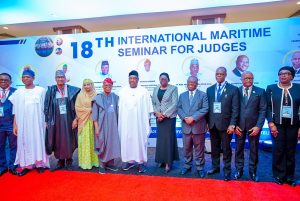
Speaking at the opening of the 18th International Maritime Seminar for Judges, organised by the Nigerian Shippers’ Council (NSC) in collaboration with the National Judicial Institute (NJI) in Abuja, Oyetola said rapid technological changes in the maritime industry were creating unprecedented legal questions that require a more specialised and forward-looking judiciary.
He noted that autonomous ships, electronic bills of lading, blockchain-enabled cargo documentation and digital freight contracts are transforming global shipping while introducing complex issues relating to liability, navigational responsibility, insurance, jurisdiction and contractual obligations.
“The prospect of vessels operating with limited or no human crews raises fundamental questions concerning liability, navigational responsibility, insurance, collision regulations and the allocation of legal responsibility when technology fails,” the Minister said.
Oyetola also pointed to the increasing global drive towards maritime decarbonisation, warning that environmental compliance, pollution liability and evolving international regulations would generate more sophisticated disputes requiring judges to combine sound legal reasoning with scientific understanding and knowledge of international maritime jurisprudence.
He stressed that an efficient and predictable judicial system remains one of Nigeria’s strongest competitive advantages in attracting global maritime investment.
“Every judgment delivered in a maritime matter sends a powerful message—not only to the litigants before the court, but also to international investors, shipowners, financiers, insurers, cargo interests and seafarers across the world,” he said.
According to him, strengthening litigation and maritime arbitration would enhance commercial confidence, lower transaction costs and position Nigerian courts and arbitration centres as preferred destinations for resolving shipping disputes across Africa.
To achieve this, Oyetola disclosed that the Federal Government would continue supporting the expansion of specialised maritime divisions within the Federal High Court, align domestic laws with international maritime conventions and strengthen alternative dispute resolution mechanisms, particularly maritime arbitration.
He described judicial excellence as a strategic economic asset, adding that investment in judicial capacity would directly improve Nigeria’s competitiveness in the global maritime economy.
Highlighting ongoing reforms in the sector, the Minister revealed that the Federal Government had secured a £746 million financing agreement with the United Kingdom for the modernisation of Apapa and Tin Can Island ports. He also noted that the approved disbursement of the Cabotage Vessel Financing Fund (CVFF) would enable indigenous shipowners to acquire vessels, expand coastal shipping operations and create an estimated 30,000 jobs.
He further stated that Nigeria has maintained four consecutive years without piracy in its territorial waters through the Deep Blue Project, while maritime agencies generated over ₦1.8 trillion in revenue in 2025. Domestic fish production, he added, has increased from approximately 1.1 million metric tonnes to 1.4 million metric tonnes.

Oyetola observed that the continued expansion of offshore renewable energy, aquaculture, seabed resource exploration and coastal tourism would inevitably increase commercial disputes involving investors, regulators, host communities and operators.
“The marine and blue economy cannot flourish in a legal vacuum,” he said, urging the judiciary to uphold the rule of law while developing the expertise required to interpret increasingly sophisticated international maritime legal instruments.
Also addressing participants, the Secretary to the Government of the Federation (SGF), Senator George Akume, emphasised the importance of speedy admiralty justice, noting that delays in resolving maritime disputes could negatively impact trade, investment, shipping operations and the wider economy.
He also urged government institutions to strengthen inter-agency collaboration, stressing that effective coordination is essential for improving port efficiency, facilitating trade and unlocking the full potential of Nigeria’s blue economy.
Declaring the seminar open, Chief Justice of Nigeria, Justice Kudirat Kekere-Ekun, described the maritime sector as a critical driver of international trade, employment and national revenue.
She stressed that maritime disputes are often complex, time-sensitive and cross-border in nature, making prompt and specialised adjudication essential for maintaining investor confidence and ensuring the smooth operation of global commerce.
The Chief Justice also highlighted the importance of international judicial cooperation, noting that maritime commerce routinely involves multiple jurisdictions and legal systems, requiring closer collaboration among courts, regulators, legal practitioners and maritime stakeholders.
Representing the Speaker of the House of Representatives, Deputy Chief Whip Hon. Ibrahim Ayokunle Isiaka reaffirmed the commitment of the National Assembly to providing the legislative framework needed to support the growth of the maritime sector through robust lawmaking and oversight.
The seminar attracted Chief Justices from The Gambia, Ghana, Kenya, Liberia and Sierra Leone, alongside Justices of the Supreme Court and Court of Appeal, Federal and State High Court judges, legal scholars, arbitrators and maritime law practitioners.
The three-day seminar runs from July 22 to July 24, 2026, focusing on strengthening judicial capacity to support Nigeria’s evolving maritime and blue economy.








Leave a Reply