


The President of the Women’s International Shipping and Trading Association (WISTA) Nigeria, Dr. Odunayo Ani, has urged African governments, regulators and industry stakeholders to strengthen collaboration and move beyond policy formulation to practical implementation that delivers measurable results for the continent’s maritime sector.
Speaking at the 8th WISTA Africa Regional Conference in Lagos, themed “From Policy to Progress: Women Delivering Africa’s Shipping and Trade Energy Future,” Dr. Ani said Africa’s Blue Economy offers immense opportunities to boost trade, improve maritime connectivity and drive sustainable economic growth through the African Continental Free Trade Area (AfCFTA).

R-L: Former Directors-General/Chief Executive Officers of the Nigerian maritime administration and safety agency; Ade dosumu, Temisan Omatseye, WISTA President Nigeria; Dr. Odunayo Ani, Former Director General; Mrs Mfon Usoro, Present Director General of Nigerian Maritime Administration and safety agency Dr Dayo Mobereola, Former Director General; Dakuku Peterside during The 8th WISTA Africa Regional Conference held in Lagos
She stressed that policies must produce tangible outcomes capable of fostering inclusive growth, innovation and competitiveness.
“Policy must translate into measurable impact, while collaboration must drive innovation. Together, we can build a more resilient, competitive and inclusive maritime industry for Africa,” she said.
Dr. Ani also commended the Federal Ministry of Marine and Blue Economy, the Nigerian Maritime Administration and Safety Agency (NIMASA), the International Maritime Organization (IMO), WISTA International and other partners for supporting the conference.
Representing the Minister of Marine and Blue Economy, Adegboyega Oyetola, the ministry’s Director of Planning, Research and Statistics, Hajia Kalthum Ibrahim, called for decisive efforts to eliminate barriers limiting women’s participation in the maritime industry.
She noted that women are already making significant contributions to the sector but require greater access to opportunities through skills development, stronger institutions, technological innovation and regional partnerships.
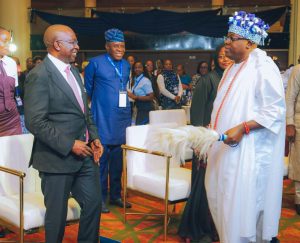
Director General of Nigerian Maritime Administration and safety agency Dr Dayo Mobereola exchanging pleasantries with the Oniru of Iruland, His Royal Majesty Oba Abdulwasiu Omogbolahan Lawal (Abisogun II) during WISTA Africa regional conference held in Lagos
Director-General of NIMASA, Dr. Dayo Mobereola, reaffirmed the agency’s commitment to gender inclusion and sustainable maritime development, describing collaboration among governments, professional bodies and industry stakeholders as critical to unlocking Africa’s maritime potential.
Delivering the keynote address, former NIMASA Director-General Dr. Dakuku Peterside challenged African leaders to shift from signing agreements to implementing policies that strengthen institutions, expand infrastructure and build human capacity.
According to him, Africa must accelerate investments in indigenous shipping, modern ports, maritime education and green shipping initiatives while creating more leadership opportunities for women, whose contributions he described as essential to the industry’s future.
The Oniru of Iru Kingdom, Oba Abdulwasiu Omogbolahan Lawal, praised WISTA Africa and WISTA Nigeria for fostering dialogue and practical solutions, describing the Blue Economy as one of Africa’s greatest opportunities for sustainable development.
Earlier, Chairperson of the Convention Planning Committee, Dr. Oma Ofodile, welcomed delegates from across Africa and beyond, describing the conference as a landmark event for WISTA Nigeria and urging participants to ensure discussions translate into concrete actions.
A high-level plenary session focused on bridging the gap between maritime policy commitments and implementation, with participants advocating stronger policy enforcement, increased investment in port infrastructure, indigenous shipping capacity, climate-resilient maritime systems and enhanced regional cooperation to position Africa for greater competitiveness in global shipping and trade.





Leave a Reply