

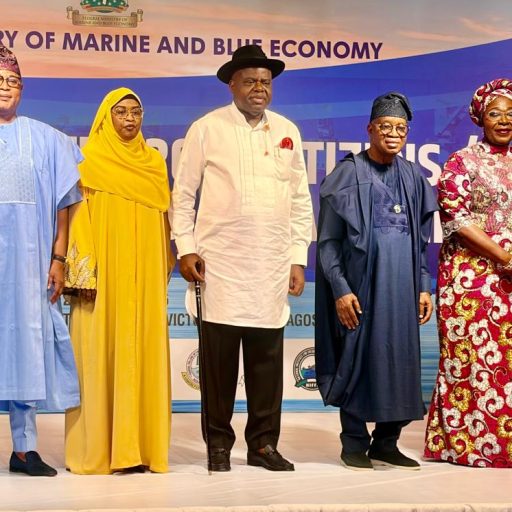
Minister of Marine and Blue Economy, Dr. Adegboyega Oyetola, has called for stronger collaboration among the Federal Government, state governments, the private sector and development partners to fast-track the implementation of Nigeria’s National Policy on Marine and Blue Economy, describing sub-national participation as the key to unlocking the nation’s vast maritime resources.
Speaking at the Second Quarter 2026 Citizens’ and Stakeholders’ Engagement organised by the Federal Ministry of Marine and Blue Economy in Lagos, Oyetola said Nigeria had moved beyond policy formulation and must now focus on effective implementation capable of delivering tangible economic benefits.
The engagement, themed “From Policy to Action: Mobilising Sub-National Governments for Effective Implementation of Nigeria’s National Policy on Marine and Blue Economy,” attracted government officials, diplomats, development partners, industry leaders,academics and representatives of state governments.
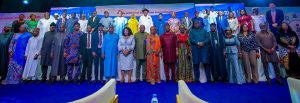
Bayelsa State Governor, Senator Duoye Diri; Minister of Marine and Blue Economy, Dr Adegboyega Oyetola; Deputy Governor of Akwa Ibom State, Senator (Dr) Akon Eyakenyi, and others at the Second Quarter 2026 Citizens’ and Stakeholders’ Engagement of the Federal Ministry of Marine and Blue Economy held at Eko Hotel and Suites, Victoria Island, Lagos on Thursday.
Oyetola noted that while the National Policy provides a strategic roadmap for harnessing Nigeria’s oceans, inland waterways, fisheries and coastal resources, its success would depend on coordinated action across all tiers of government.
According to him, many of the country’s blue economy assets are located within states and local communities, making sub-national governments indispensable partners in attracting investment, creating jobs, enhancing food security and promoting environmental sustainability.
The minister highlighted key reforms under President Bola Ahmed Tinubu’s Renewed Hope Agenda, including improved stakeholder engagement, enhanced maritime safety, increased investment and greater competitiveness of Nigeria’s ports.
He pointed to the 2025 Container Port Performance Index by the World Bank and S&P Global Market Intelligence, which ranked Tin Can Island Port as the 10th most improved port globally and Lagos Port Complex, Apapa, as the 12th most improved between 2020 and 2025.
Oyetola also disclosed that ongoing port modernisation and plans to develop new deep seaports in Akwa Ibom, Bayelsa, Cross River, Lagos and Ondo States would further position Nigeria as West Africa’s preferred maritime hub.
On inland waterway transportation, he said the ministry had intensified collaboration with relevant agencies and state governments to improve safety through the nationwide distribution of life jackets and urged states to phase out unsafe wooden passenger boats in favour of modern fibre boats.
He further encouraged coastal states to align their development strategies with the national policy while creating an enabling environment for private investment in fisheries, aquaculture, maritime transport, tourism, shipbuilding, renewable energy and marine biotechnology.
Delivering the keynote address, Bayelsa State Governor, Senator Douye Diri, described the creation of the Federal Ministry of Marine and Blue Economy as a strategic step towards diversifying Nigeria’s economy.
Diri said Bayelsa established its own Ministry of Marine and Blue Economy in 2024 to drive the state’s development agenda, adding that the state had commenced large-scale fish production at its Aquaculture Village in Yenegwe and was advancing plans for the proposed Agge Deep Seaport.
He urged coastal states to establish dedicated marine ministries, enact enabling legislation, secure their maritime domains, invest in data-driven planning and strengthen skills development, innovation and logistics infrastructure.
Also speaking, President and Chief Executive of Dangote Industries Limited, Aliko Dangote, represented by the Managing Director of Dangote Port Operations, Simeon Akin Omole, said sustained private sector participation would determine the success of the National Policy on Marine and Blue Economy.
Dangote noted that the policy targets the creation of three million jobs within four years, seven per cent annual sectoral growth and the reservation of at least half of new jobs for young Nigerians.
He identified infrastructure development, value-chain expansion and stronger public-private partnerships as the three critical pillars required to unlock the sector’s enormous investment opportunities.
He added that investments in fisheries, aquaculture, processing, cold-chain logistics and export infrastructure could significantly reduce Nigeria’s dependence on fish imports, conserve foreign exchange, create over 500,000 jobs and position the country as a leading exporter of fisheries products.
Other goodwill messages were delivered by the Deputy Governor of Akwa Ibom State, Senator Akon Eyakenyi, Chairman of the Senate Committee on Marine Transport, Senator Wasiu Sanni Eshinlokun, representatives of the governors of Ondo and Borno States, as well as private sector stakeholders, who reaffirmed their commitment to advancing Nigeria’s marine and blue economy agenda.



Leave a Reply