


Nigeria has taken a decisive step in the fight against illegal fishing in West Africa, agreeing to serve as the pilot country for the implementation of a Regional Record of Authorised Fishing Vessels across the Gulf of Guinea.
The commitment was announced by the Minister of Marine and Blue Economy and Chairman of the Conference of Ministers of the Fisheries Committee for the West Central Gulf of Guinea (FCWC), Dr. Adegboyega Oyetola, during a high-level meeting with the organisation’s Secretary-General and secretariat officials in Abuja.
By hosting the pilot phase, Nigeria aims to demonstrate practical leadership in strengthening transparency, accountability, and cross-border collaboration in fisheries governance within the sub-region.

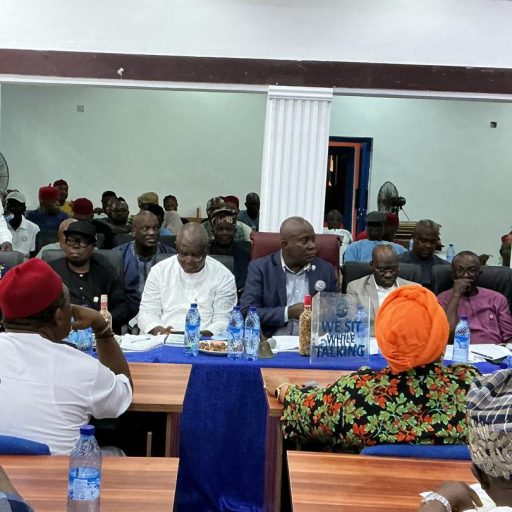
L-R: Minister of Marine and Blue Economy and Chairman of the Conference of Ministers of the Fisheries Committee for the West Central Gulf of Guinea (FCWC), His Excellency Dr. Adegboyega Oyetola, CON; FCWC Secretary-General, Antoine Gaston Djihinto, and the Director of Fisheries and Aquaculture, Mr. Wellington Omoragbon, when Djihinto led the FCWC secretariat staff on a working visit to the Minister in his office in Abuja, recently.
The proposed Regional Record will establish a verified database of industrial fishing vessels authorised to operate within the maritime jurisdictions of FCWC member states, covering both national and foreign fleets. The system is designed to tackle the persistent challenge of illegal, unreported, and unregulated (IUU) fishing, which continues to undermine marine resources, food security, and coastal livelihoods in the Gulf of Guinea.
Dr. Oyetola said the pilot phase would test operational feasibility, identify gaps, and generate lessons to guide a broader regional rollout. He assured that Nigeria would leverage its experience to support other member states when implementation expands.
“The project is envisaged as a formalised and validated regional database containing comprehensive and reliable information on fishing vessels authorised to operate within the maritime jurisdictions of FCWC Member States,” he stated. “This initiative represents a major step forward in strengthening transparency, accountability and cooperation in fisheries governance across our shared waters.”
The initiative builds on commitments outlined in the Monrovia Declaration and aligns with broader enforcement efforts under the West Africa Sustainable Ocean Programme, implemented by the FCWC in partnership with the European Fisheries Control Agency.
The Minister also disclosed that Nigeria’s draft National Plan of Action on illegal fishing is undergoing review following the transfer of fisheries oversight to the Federal Ministry of Marine and Blue Economy. The review, he said, underscores the government’s determination to address illicit fishing activities more effectively.
Beyond the vessel register, Dr. Oyetola proposed deeper institutional collaboration with the FCWC, including a high-level Nigerian mission to the organisation’s secretariat and regional monitoring centre. He also advocated harmonisation of fisheries regulations and food safety standards among member states to boost trade and enhance consumer protection.
Reaffirming Nigeria’s commitment to regional cooperation, he pledged that his tenure as Chairman of the FCWC Conference of Ministers would prioritise measurable outcomes, stronger institutions, and sustainable use of ocean resources.
Earlier, FCWC Secretary-General Antoine Gaston Djihinto commended Nigeria’s leadership and its renewed push to combat IUU fishing, as well as efforts to strengthen fish production domestically. He also praised the Ministry for hosting what he described as an “outstanding and highly commendable” FCWC Conference in Lagos in November 2025.
Established in 2007 and headquartered in Tema, Ghana, the Fisheries Committee for the West Central Gulf of Guinea comprises six member states — Benin, Côte d’Ivoire, Ghana, Liberia, Nigeria, and Togo — and works to promote sustainable fisheries management, harmonise legislation, and enhance monitoring and surveillance across West Central Africa.






Leave a Reply